
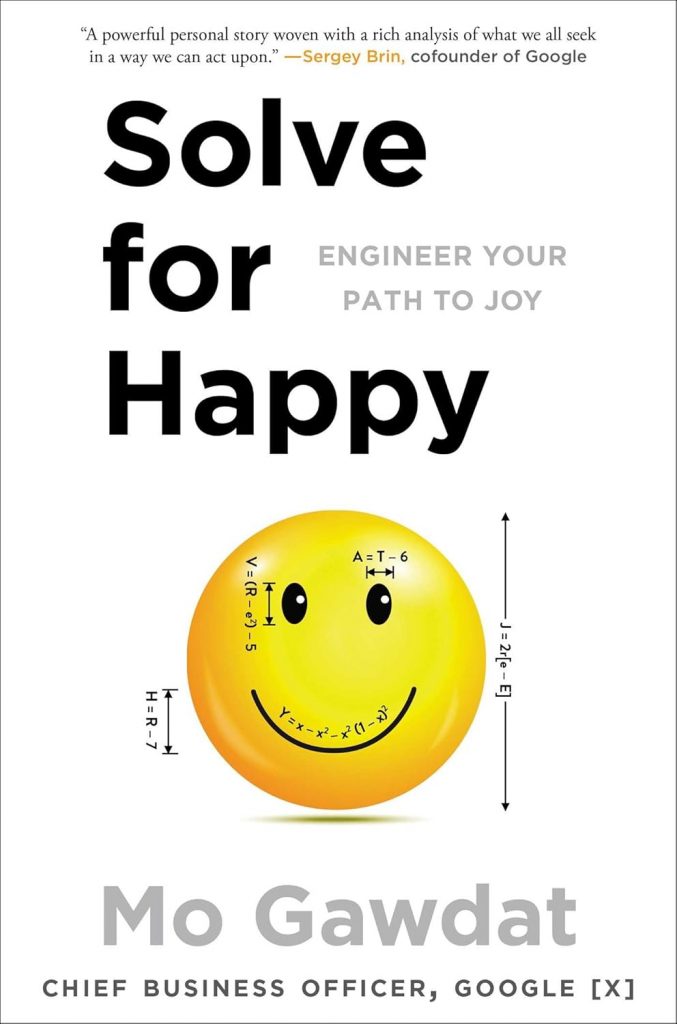
Mo Gawdat, chief business officer at Google, took an engineer’s approach to the problem of happiness after the tragic loss of his son. In his 2017 book, Solve for Happy: Engineer Your Path to Joy, Gawdat shares that happiness is not a goal to be achieved, but our natural, default state. The key to living a joyful life is to remove the obstacles that prevent us from experiencing this innate happiness. Gawdat identifies these obstacles as “grand illusions” and “blind spots” that cloud our perception of reality. By understanding and dismantling them, we can realize “ultimate truths” and return to our baseline state of joy.
This is our fourth recent post in our series on happiness. We encourage you to review our previous posts:
Equations for a Great Life from Scott Galloway’s Algebra of Happiness,
How to Stop Stumbling on Happiness, and
How a Positive Mindset Results in a Happiness Advantage.
6 Grand Illusions
Gawdat argues that we live with six fundamental illusions that cause unnecessary suffering. They are not truths, but rather misconceptions we have accepted as real. He spends nearly half the book exposing these 6 grand illusions.
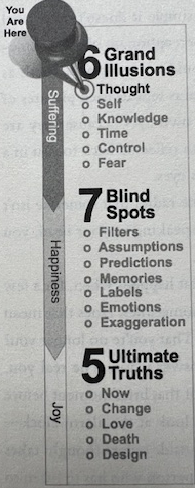
- Thought: We mistakenly believe our inner monologue is who we are. In reality, it is just our brain’s way of processing information. We can choose to observe our thoughts without identifying with them.
- Self: We think we are the main character of our lives, the center of the universe. This is an illusion; we are simply an observer of the world. We can find peace by letting go of the need to be in control.
- Knowledge: We believe we know more than we actually do. True wisdom lies in accepting our own ignorance.
- Time: The past and future are illusions. When we focus on the past or the future, we’re living in our thoughts, and not in reality. The only real moment is now. Unhappiness is often rooted in regrets about the past or anxieties about the future, both of which don’t truly exist.
- Control: We believe we have control over events, but we don’t. The only thing we can truly control is our perception of and reaction to them. We all choose our attitude.
- Fear: We are under the illusion that bad things won’t happen. They always do, but we can face our fears and ask ourselves, “how bad can it be?” By accepting that bad things are a part of life, we can free ourselves from the constant fear of them.
7 Blind Spots
Beyond the grand illusions, Gawdat outlines seven “blind spots” that distort our perception and create a mismatch between reality and our expectations.
- Filters: Our brain filters reality, only showing us what it deems important, which can lead to an incomplete picture.
- Assumptions: We fill in the gaps with assumptions instead of seeking the truth. Remember that an assumption is nothing more than a brain-generated story; it’s not the truth.

- Predictions: These are brain-generated future possibilities. They have not happened, are not the truth, and are often wrong.
- Memories: Our memories are not always reliable; they are often reconstructed and can be influenced by our current emotions. We should trust our memory less than we do.
- Labels: We use labels to categorize people and things, which simplifies reality in our brain while also distorting it. In the absence of context, labels often cover up the truth.
- Emotions: Our emotions can color our perception, causing us to see things through a biased lens. We are often not as rational as we think.
- Exaggeration: We tend to exaggerate the negative aspects of events, making them seem worse than they are. It is best to teach your brain to tell the truth, the whole truth, and nothing but the truth.
Choose to be Happy
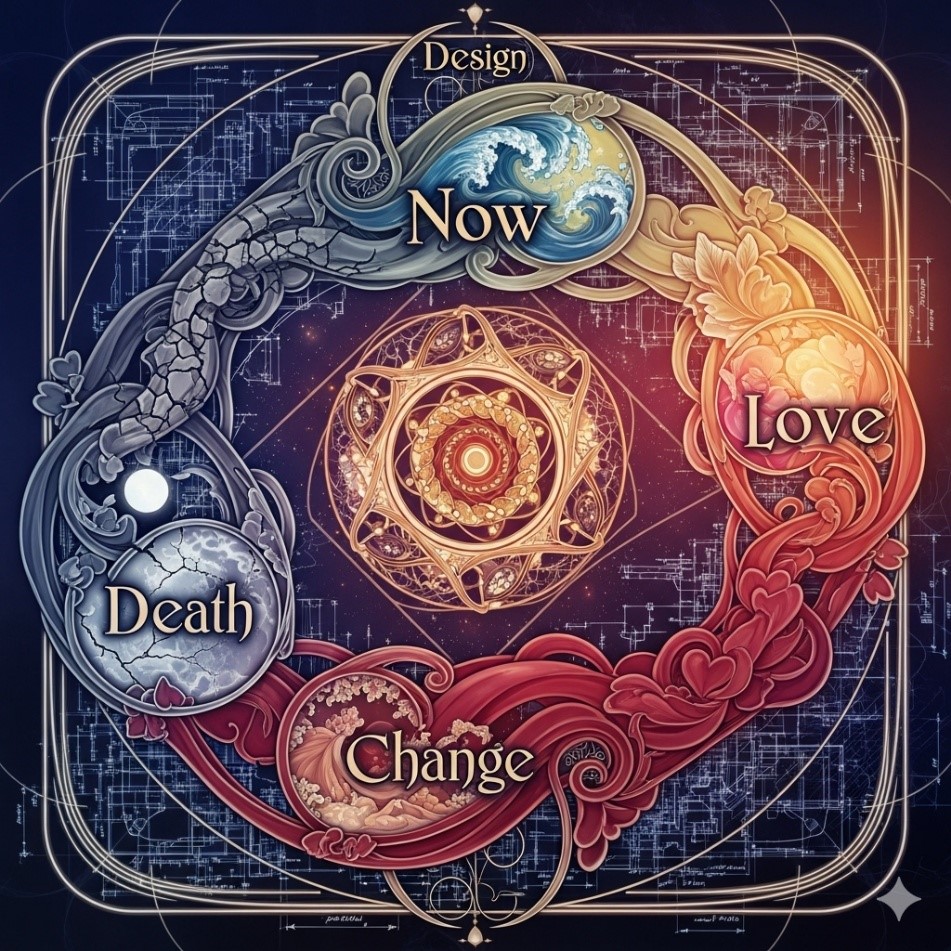
To counter the 6 grand illusions and 7 blind spots, Gawdat offers 5 ultimate truths that are the foundation for lasting happiness. He clarifies that these are his five truths he arrived at after the unexpected loss of his 21-year-old son due to a medical error. Gawdat notes that two of his ultimate truths (love and design) might be controversial.
Here is Gawdat’s happiness equation:
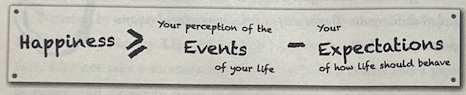
Gawdat encourages us all to realize that happiness is our default state. It is the absence of unhappiness. Dealing with illusions and blind spots will help us remove unhappiness. Here are his simple reminders:
- “Every truth happens exactly as expected, even when you least expect it.”
- “When nothing is certain – and nothing ever is – choose to be happy.”
- “If you aren’t sure about what is true, choose to believe in the side that makes you happy.” This is Gawdat’s Golden Rule of Happiness.
Mo Gawdat’s 5 Ultimate Truths
- Now: The present moment is the only one that exists, and it is the source of all joy. The secret to improving your awareness is to do nothing. Awareness is our default state! Whatever you do, give it your undivided attention. Live your life here and now, not inside your head.
- Change: Everything in life is in a state of constant change. We should embrace this truth instead of fighting against it. Gawdat encourages us to set realistic expectations (see the equation above) and focus on gratitude. Gratitude is a sure path to happiness.
- Love: Love, which is unconditional and freely given, is a powerful force for happiness. Unconditional love is real; it’s the only emotion not generated by a thought in your head. The more love you give, the more you will get back.
- Death: Accepting our mortality allows us to live more fully and appreciate each day. There is no cheating death but remember that death will never hurt you. Gawdat believes in reincarnation and encourages us to have fun in our short time on earth.
- Design: Life is a beautiful design, and by trusting in it, we can find peace. Gawdat spends the last 30+ pages of the book sharing his thoughts on the existence of a grand designer. We will review this argument in a future post.
Summary
Solve for Happy: Engineer Your Path to Joy provides a logical, engineering-based framework for understanding and achieving happiness. By recognizing that happiness is our default state, we can focus on dismantling the six grand illusions and correcting the seven blind spots that cloud our perception. By grounding ourselves in the five ultimate truths, we can restore our connection to the present moment and reclaim joy.
Please share your comments and questions about the book and our post below.