
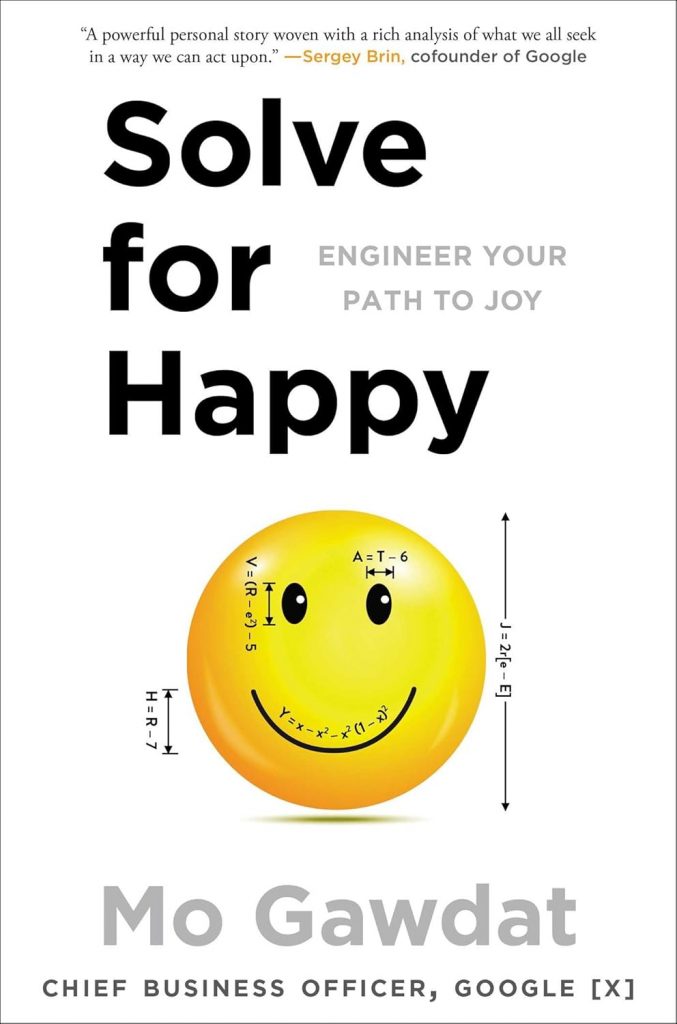
A recent post summarized Mo Gawdat’s 2017 book, Solve for Happy: Engineer Your Path to Joy. Gawdat shares six “grand illusions,” seven “blind spots”, and five “ultimate truths” in his very thought-provoking book on happiness. The final chapter of the book is titled “Who Made Who?” and is an engineer’s reasons for the existence of a grand designer. I found this section didn’t fit particularly well with the rest of the book, but his argument was persuasive enough to share with the Personal Kaizen community and explore separately.
The Problem Statement
Trying to tackle the existence of God as the final chapter of a book is ambitious. Like any good engineer, Gawdat begins by defining the initial problem statement about God that he is trying to solve. He tries to address the most fundamental question first, “Is there a Designer,” before addressing any follow-up questions concerning God related to prayer, judgment, the afterlife, and religious doctrine. If Gawdat finds there is no Designer, then the other questions clearly don’t matter.
Gawdat finds it challenging to find proof of the existence of God. He believes this debate is the wrong one, realizing:
- There is no scientific way to prove that something doesn’t exist, and
- Absence of proof that something exists does not prove that it doesn’t.
With these key points in mind, Gawdat decides to study the probability of the existence of a Grand Designer.
The problem with big numbers
There is a theorem that states that a monkey hitting keys independently and at random on a keyboard for an infinite amount of time will type any given text, including the complete works of William Shakespeare. While this theorem has a mathematical proof, Gawdat notes that the probability of this occurring is infinitesimally small, since it would take much longer than the time the entire universe has existed to randomly type the right sequence, much less add the proper spaces and punctuation. Random results are possible, but only using large time frames.

The universe has a mathematical order
We can all see that the universe is not chaotic and is governed by precise mathematical laws and fundamental constants. Gravity and the speed of light are consistent and predictable laws. Gawdat sees this order not as a random occurrence, but as evidence of a meticulous plan. The fine-tuning of these constants, which allow for the formation of stars, galaxies, and life itself, suggests an intentional design rather than pure chance.
What about evolution?
If one believes in the existence of a Grand Designer, are we saying that evolution and natural selection are not happening? Gawdat discusses this in the book, stating:
“Please don’t get me wrong: evolution is a scientific fact. There’s no point arguing that. We see evidence of it all around us. But often when evolution is discussed, a small detail is overlooked: a distinction between micro- and macro- evolution.”
The natural world is full of examples of elegant design. From the intricate structure of a snowflake to the complex systems within a single cell, life demonstrates a level of sophistication that goes beyond random evolution. Gawdat points out that the human eye, for instance, is a marvel of engineering, with all its components working together perfectly to process light and form an image. He believes this level of efficiency points to an intelligent designer, much like a complex machine points to a skilled engineer.
Did your iPhone evolve?
Gawdat asks what would happen if, many years from now, after our civilization has ended, a fossilized iPhone is dug up and examined. Would we believe that this iPhone naturally evolved from an earlier phone or from an iPod? Or would we rather find it more likely that the screen, aluminum case, and software were designed by a team at Apple for a specific purpose?

Gawdat strongly believes that there hasn’t been enough time in our universe for all creatures to have evolved from a single point. He also points out instances where the differences between species expected through evolution are not found in the fossil record. To Gawdat, this leads to the probability of a Grand Designer.
Is Gawdat’s argument for a Grand Designer convincing?

I have considered Gawdat’s argument and discussed his points with friends and colleagues. The final chapter of Solve for Happy: Engineer Your Path to Joy makes many logical, fact-based points that do not disprove the existence of a Grand Designer. My main critique of his argument is that it does little to prove the existence. This is the problem with all of the conspiracy theories we hear today; it is not enough to raise doubt, you actually need to show factual proof of your conspiracy.
I know from the book that Gawdat has had some Buddhist teachings that he really wants to believe. He also wants to believe that his son will have an afterlife and that they will meet in it. His hopes are dependent upon believing this argument, but this belief in a Grand Designer does lead to the issue of infinite regress, best represented by the famous “it’s turtles all the way down” comment.
Summary
I have one last point to consider: does Gawdat’s reasons for the existence of a Grand Designer change anything? Will believing or not believing his argument affect anything in how I live my life?
Gawdat’s problem statement only asks whether the Big Bang was likely part of a design or random. Even if you decide to believe that a Designer created the universe and fundamental truths, Gawdat does not argue that this Designer has any impact on our day-to-day lives. If the Designer has no impact on the Universe, then whether I believe in a Designer or pray to God has no impact. For me, a fair answer to the question, “Is there a Grand Designer?” is, therefore, “it doesn’t matter to my life.”
Solve for Happy: Engineer Your Path to Joy provides a logical, engineering-based framework for understanding and achieving happiness. If you want to see Gawdat’s full argument, I suggest you read the entire final chapter of the book.
I found Gawdat’s argument to be well reasoned, but with a key logical fallacy. More importantly, in my pursuit of personal kaizen, the answer to his question has no impact on how I live my life.
Please share your comments and questions below.