

In the philosophy we share with our Personal Kaizen community, Rule 6 of our 10 Rules for Life is to Learn and Grow throughout your Life. The moment we stop being students of the world is the moment we begin to stagnate. Traditionally, constant learning and growth required finding the right books, seeking out mentors, or enrolling in expensive courses. But as we write this in early 2026, Artificial Intelligence has shifted the paradigm from “searching for information” to “architecting knowledge.” AI is no longer just a chatbot; it is a personalized tutor, a research assistant, and a sparring partner that never gets tired of your questions.
Here are five transformative ways to begin an AI Apprenticeship and embody the spirit of continuous improvement. Use these AI tools to supercharge your growth in 2026 and fuel your lifelong learning journey.
1. Create Your Own Curriculum with NotebookLM

The greatest barrier to learning a new, complex subject is often the overwhelming amount of unorganized data. Google’s NotebookLM changes this by allowing you to create a grounded AI environment.
Instead of searching the open web, you can upload specific sources (PDFs of textbooks, saved blog posts, or even long-form videos) into a notebook. From there, you can ask the AI to “create a 6-week syllabus based on these documents.” NotebookLM can generate study guides, glossaries of key terms, and even audio overviews that sound like a professional podcast discussing your specific material.
Get started: It is easy to create your first notebook and start using the tool, or go to NotebookLM and click on one of their featured notebooks to explore. For this post, their existing notebook on “How to Study” is particularly relevant.
2. Practice High-Stakes Conversations with Role-Play
Growth often happens at the edge of our comfort zones, particularly in how we communicate. Whether you are preparing for a difficult performance review, a sales pitch, or a board meeting, AI can serve as a risk-free “flight simulator.” Using advanced LLMs (try the latest offerings from ChatGPT or Claude), you can set a detailed persona and start a conversation.
Get started: Log in to your AI and begin by defining the AI persona for the conversation. For example: “Act as a skeptical venture capital investor who is concerned about our scaling costs. I am going to pitch you, and I want you to push back on my financial assumptions.”
By engaging in a back-and-forth dialogue, you identify gaps in your logic and refine your delivery. You can even ask the AI for a “post-game analysis” to see where your tone was defensive or where your explanations lacked clarity.

3. Master New Languages through Immersive Context
Learning a language is the ultimate growth hack. It re-wires the brain and opens up entire new cultures for further learning.
Traditional language learning often fails because it focuses on rote memorization rather than natural flow. New AI-driven tools (like Wispr Flow or the standard voice modes in mobile AI apps) enable real-time spoken conversation in dozens of languages. Wispr Flow’s free plan currently allows you to speak 2,000 words per week in 10 different languages.

Unlike a human tutor who might be expensive or unavailable at 10:00 PM, an AI is ready to practice whenever you are. You can ask the AI to “Speak to me in Spanish as if we are at a local market in Madrid, and gently correct my grammar after each sentence.” This provides the “just-in-time” learning that helps the brain retain information far more effectively than flashcards alone. I have used Duolingofor many years now (with a 3,000-day-long streak) and have benefited from the AI conversational improvements they have made over the past year.
Get started: Download Duolingo and create a free account to begin simple lessons in the language of your choice.
4. Break the “Blank Page” Barrier in Skill Acquisition
We often fail to grow because the starting line looks too far away. If you want to learn to code, play an instrument, or master digital photography, you can likely find tutorials on YouTube, but sifting through these videos to find the good stuff can be paralyzing.

AI can act as a Dynamic Step-Generator. If you tell an AI, “I want to learn how to use Python to automate my email sorting, but I have zero coding experience. Give me the first three steps and explain them like I’m a beginner,” it breaks the mountain into molehills. The best part is that you can tell the AI your background and preferred learning style.
Tools like Cursor (for coding) or Midjourney (for visual arts) allow you to see results instantly. This “tight feedback loop” is essential for dopamine-driven learning; when you experience a small win immediately, you are much more likely to return for the next lesson.
Get started: Use AI to become better at using AI! When I was first experimenting with how AI could help me in business and life, asking the AI for suggestions and then step-by-step instructions moved me forward. Try this for free on Google Gemini today!
5. Synthesize Management and Psychology Books
For the busy professional, reading every “must-read” book is impossible, and Lean East summaries only cover a few dozen of my favorite books. Plus, the world changes so fast nowadays that most books about AI and Tech will be out of date by the time they are published.
Get started: AI enables new tools to support the lifetime learning and growth at the core of Rule 6. Here are a few ways you can use AI for leadership and psychological insights.
- Ask your favorite AI tool to summarize a book that you haven’t read and share the lessons about a topic of interest: For example, “Summarize the top three coaching lessons in Marshall Goldsmith’s newest book.” I entered this prompt into my go-to AI, Gemini, and received a great answer and a link to an hour-long YouTube video featuring Marshall Goldsmith describing the lessons himself!
- You can use AI to perform “Active Synthesis.” Instead of reading a 300-page book for two gems of wisdom, use AI to compare and contrast ideas. You might ask: “Compare the concept of ‘Flow’ from Mihaly Csikszentmihalyi with the ‘Deep Work’ philosophy of Cal Newport. How can I combine these into a daily schedule?” By forcing the AI to synthesize different schools of thought, you are engaging in higher-order thinking. You aren’t just memorizing a summary; you are investigating how these truths interact with your specific life and career.
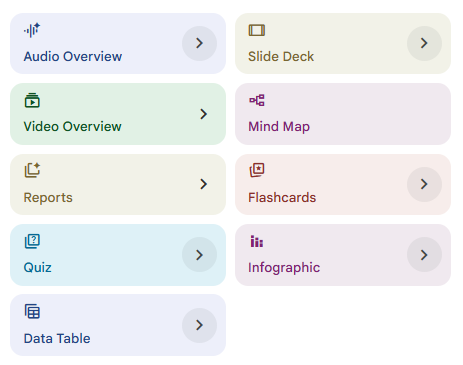
- Add PDFs of books (or information from other sources) into Google’s NotebookLM and create a slideshow, podcast, slide deck, or other summary of the information. You can also chat directly with the AI, and remember that it will only provide answers based on your sources. The graphic to the right shows some of the options available (as of April, 2026; there will likely be better tools available in NotebookLM by the time you read this post).
The Small Step Forward
The Personal Kaizen approach isn’t about mastering AI overnight. It’s about the 1% gains every day. Start by scheduling one hour in your calendar to explore one of the methods above. We have made it very easy for you to get started.
In the past, the gatekeepers of knowledge were institutions and libraries. Today, the only gatekeeper is your own curiosity. Rule 6 reminds us that we have a responsibility to our future selves to keep growing. With AI as your apprentice, that growth is no longer a chore. It’s an adventure. Keep learning, keep growing, and keep moving forward.